Hiring guide
Penetration test rescheduling without losing the deadline
Penetration test rescheduling is common. Releases slip, owners go on leave and incidents take priority. However, moving the window has knock-on effects on authorization, contacts and the report date, so it should be handled in writing.
- Signed scope before testing
- Fixed price agreed in writing
- OWASP and PTES methods
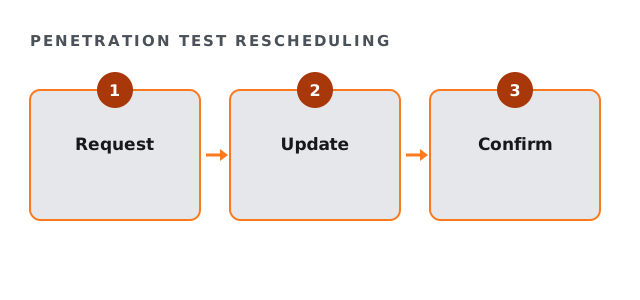
Why penetration test rescheduling happens
The usual reasons are on the buyer's side: a delayed release, a change freeze or a missing approval. Sometimes the firm needs to move too.
Either way, the cause matters less than the process, because a clear written change keeps everyone aligned.
What changes when the window moves
However, dates appear in several documents. When one moves, the others must follow. Otherwise the authorization may cover dates that are no longer used.
So list every document that carries a date, then update each one.
| Document | What to update |
|---|---|
| Authorization | New dates, signed again by owners |
| Rules of engagement | Testing hours and contacts |
| Contact list | Who is reachable in the new window |
| Report date | Moves with the window |
| Third-party notices | Providers told of the new dates |
Penetration test rescheduling checklist
Tick each update once it is done.
Your result appears here as you tick, so you can see what is still open.
Authorization and penetration test rescheduling
Authorization often names the testing dates. If the window moves, owners should confirm the new dates in writing. Testing outside the signed window is not covered.
Therefore treat a date change as a small scope change. It takes minutes, but it must be signed.
Protecting the evidence deadline
If an auditor or customer is waiting, work back from their date. A later window may still fit if the report and retest are planned tightly.
If it does not fit, narrow the scope rather than skip steps. As a result, some evidence arrives on time.
Penetration test rescheduling terms
The agreement should say how much notice is needed and whether any fee applies. Because both sides know the rule, a move does not become a negotiation.
Also agree how the firm tells you if it needs to move. The same notice period should apply both ways.
Moving a window with us
Send the new dates in writing. We update the scope and rules of engagement, and testing begins within 48 hours of the new authorization.
Full engagements run from $35,000 to $120,000, and the floor is $25,000. The bounded Focused Exposure Review starts at $4,500. Its fee is credited in full against a full engagement commissioned within ninety days. One fixed number is agreed after the scoping brief, and it never moves during the project. The method follows the Penetration Testing Execution Standard.
Penetration test rescheduling questions
How much notice does penetration test rescheduling need?
The agreement should say. A week or more is common.
Does penetration test rescheduling need new authorization?
If the dates are named, owners confirm the new ones in writing.
Is there a fee?
Check your terms. The rule should be written before the test.
Can penetration test rescheduling protect a deadline?
Yes, if the report and retest are planned back from that date.
Related guides
Plan penetration test rescheduling in writing
Send your current and new dates. We reply with an updated scope and one fixed number.
Get a fixed price