Hiring guide
Fixed price penetration testing, and what keeps the number fixed
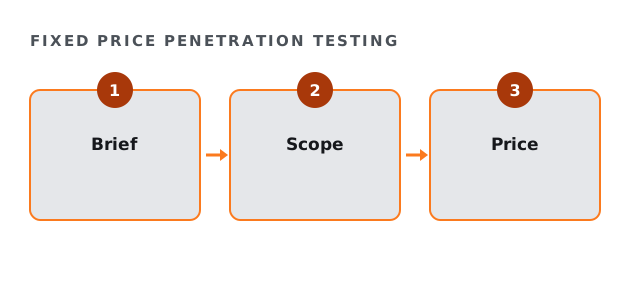
Fixed price penetration testing means one number for one written scope. You know the cost before anyone starts. However, a fixed price only works if the scope is precise, so most of the effort goes into the brief.
- Signed scope before testing
- Fixed price agreed in writing
- OWASP and PTES methods
Why buyers prefer fixed price penetration testing
Hourly billing puts the risk on the buyer. If the work takes longer, the invoice grows. With a fixed price, the firm carries that risk, so budgets hold.
In addition, a fixed price makes comparison easier. Because each firm quotes one number for the same scope, the proposals line up side by side.
How the price is set
The firm reads the brief, asks questions in writing and drafts a scope. Then it prices that scope. The more specific the brief, the faster and tighter the number.
Also expect the price to reflect depth. Two scopes with the same systems can differ if one asks for more manual work.
| Input | Effect on the price |
|---|---|
| Number and size of systems | More systems, more days |
| Depth of testing | Manual chains take longer than surface checks |
| Reporting needs | Board summaries and evidence letters add time |
| Testing windows | Narrow windows can stretch the schedule |
| Retest | Usually included or priced in advance |
Fixed price penetration testing check
Tick what your quote already shows.
Your result appears here as you tick, so you can see what is still open.
What keeps fixed price penetration testing fixed
A precise scope with clear exclusions. If the scope says exactly what is in and out, there is nothing to argue about later.
Then the agreement should say the number does not move during the project. So the invoice matches the quote.
When new work is quoted separately
Sometimes testing reveals a system nobody listed, or the business adds a new product. That is new scope. It needs the owner's signed authorization and its own price.
As a result, the original number stays intact, and the new work is a separate, clear decision.
Red flags in fixed price penetration testing
A price given before any scoping is a guess. A quote with vague scope invites disputes. And a fixed price with a long list of possible extras is not really fixed.
Therefore ask for the scope and the number together, in writing.
Our pricing
Fixed fee, never hourly. One price for the agreed scope, confirmed after the scoping brief, and no change orders during the project.
Full engagements run from $35,000 to $120,000, and the floor is $25,000. The bounded Focused Exposure Review starts at $4,500. Its fee is credited in full against a full engagement commissioned within ninety days. One fixed number is agreed after the scoping brief, and it never moves during the project. The method follows the Penetration Testing Execution Standard.
Fixed price penetration testing questions
Is fixed price penetration testing more expensive?
Not necessarily. It moves the overrun risk to the firm, and budgets hold.
What can change a fixed price penetration testing quote?
Only new scope, which is quoted separately.
How is the price set?
From a written scope, after the firm reads your brief.
Does fixed price penetration testing include the retest?
Check the quote. Many firms include one.
Related guides
Get a fixed price penetration testing quote
Tell us what you need tested, and why. We reply with a written scope and one fixed number.
Get a fixed price