Hiring guide
The penetration test executive summary, for people who fund the fixes
A penetration test executive summary is the part of the report most leaders actually read. It explains the result in business terms. So it decides whether fixes get budget, and it deserves a clear standard in the contract.
- Signed scope before testing
- Fixed price agreed in writing
- OWASP and PTES methods
What a penetration test executive summary is for
Engineers need detail. Executives need a decision. A severity rating alone tells a board member very little, because it does not say what could happen to the business.
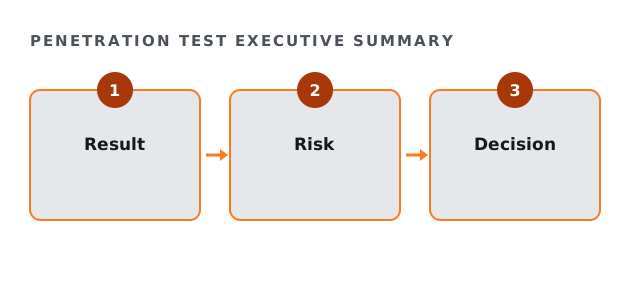
Therefore the summary translates. It says what was tested, what was found, what it means and what should happen next.
What the penetration test executive summary should contain
Keep it short. Two pages is usually enough, and one is often better. Then link to the detail for anyone who wants more.
Also ask for plain words. If a sentence needs a security background to understand, it belongs in the findings section.
| Part | What it says |
|---|---|
| Scope | What was tested, and when |
| Overall result | The headline in one or two sentences |
| Key risks | What could happen to the business |
| Priorities | What to fix first, and why |
| Limits | What was not tested |
Penetration test executive summary review
Tick what the summary in front of you does.
Your result appears here as you tick, so you can see what is still open.
Writing standards to agree in advance
Agree the format before the test. For example, ask for a summary a non-technical director could read in five minutes.
In addition, ask that the summary names the scope limits. As a result, nobody reads a narrow test as a full one.
Using the penetration test executive summary
Share it with the sponsor and the board, and keep the full report on a named list. Because the summary carries less detail, it travels more safely.
Then use it to set the remediation budget. Priorities in the summary should match the plan engineers receive.
Common weaknesses
Some summaries repeat the findings list in shorter form. Others use only severity counts. Neither helps a leader decide.
So ask one question of any sample. After reading it, would a director know what to fund?
Our summary
Every engagement includes a business risk summary of two pages your board can read, alongside the findings report, a prioritized remediation plan, a written debrief and a free retest.
Full engagements run from $35,000 to $120,000, and the floor is $25,000. The bounded Focused Exposure Review starts at $4,500. Its fee is credited in full against a full engagement commissioned within ninety days. One fixed number is agreed after the scoping brief, and it never moves during the project. The method follows the Penetration Testing Execution Standard.
Penetration test executive summary questions
How long is a penetration test executive summary?
Usually one or two pages.
Who reads the penetration test executive summary?
The sponsor, executives and the board.
Can we share it outside the company?
Sometimes, but check what it reveals first. A letter is often safer.
Should the penetration test executive summary list limits?
Yes, so a narrow test is not read as a full one.
Related guides
See a penetration test executive summary format
Send a short brief. We reply with a written scope that lists every deliverable, and one fixed number.
Get a fixed price