Hiring guide
The penetration testing MSA, clause by clause
A penetration testing MSA is the master services agreement that sits above each piece of work. It is signed once. Then each engagement is added as a short scope, so later tests start faster and the core terms stay the same.
- Signed scope before testing
- Fixed price agreed in writing
- OWASP and PTES methods
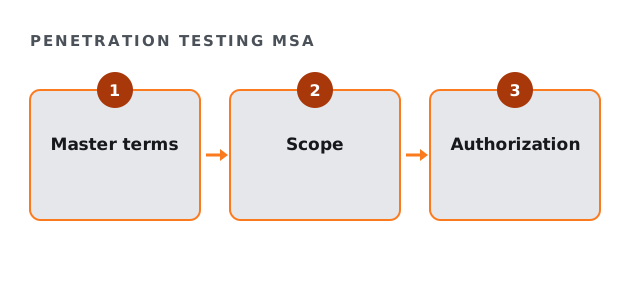
Why a penetration testing MSA helps
Without master terms, every test means a full contract review. That can add weeks. With an MSA in place, legal reviews the big questions once, and each new engagement needs only its scope and authorization.
In addition, the terms stay consistent. So data handling and liability do not change from one test to the next by accident.
What a penetration testing MSA should contain
Keep the agreement focused on the terms that apply to every engagement. Anything specific to one test belongs in its scope.
Then check that the two documents point to each other. Because the scope relies on the MSA, the link must be explicit.
| Clause | What to check |
|---|---|
| Confidentiality | Covers findings, reports and every person involved |
| Data handling | Storage, access and destruction after delivery |
| Authorization | No testing without the owner's signed scope |
| Liability | Caps and exclusions are clear and mutual |
| Payment | Fixed fee per scope, invoicing and due dates |
| Term and exit | How either side ends the agreement |
Penetration testing MSA review list
Tick each clause your draft already covers.
Your result appears here as you tick, so you can see what is still open.
Authorization in the penetration testing MSA
The MSA should never authorize testing on its own. Instead, it should say that each engagement requires a written scope signed by the system owner. Laws such as the US Computer Fraud and Abuse Act guidance turn on that signature.
So the master terms set the rules, and the scope gives permission. Therefore keep both roles clear.
How scopes attach to the penetration testing MSA
In practice, each new engagement is a short document: systems, dates, rules of engagement and the fixed fee. It refers to the MSA for everything else.
As a result, a new test can move from brief to signed scope in days rather than weeks.
Common gaps
For example, one gap is an MSA that allows scope to grow without a new signature. Another is a data clause that says nothing about destruction. Both are easy to fix before signing.
Also check the order of precedence. If the MSA and a scope disagree, the agreement should say which one wins.
How we contract
Every engagement rests on three documents: the scope of work, written authorization from the system owner and the rules of engagement. Testing begins within 48 hours of authorization.
Full engagements run from $35,000 to $120,000, and the floor is $25,000. The bounded Focused Exposure Review starts at $4,500. Its fee is credited in full against a full engagement commissioned within ninety days. One fixed number is agreed after the scoping brief, and it never moves during the project. The method follows the Penetration Testing Execution Standard.
Penetration testing MSA questions
Do we need a penetration testing MSA for one test?
Not always. A single contract works for a one-off engagement.
Does a penetration testing MSA authorize testing?
No. Each engagement still needs a scope signed by the system owner.
Who reviews it?
Legal and security, once, before the first engagement.
How long does a penetration testing MSA last?
Usually a set term, renewed or ended in writing.
Related guides
Request a penetration testing MSA draft
Send a short brief and your standard terms. We reply with a written scope, our master terms and one fixed number.
Get a fixed price